Wednesday, May 2, 2012

St. Petersburg, Russia & Helsinki, Finland, April 2012

Street musicians outside the Church of the Savior on Spilled Blood.

St. Petersburg, Russia & Helsinki, Finland, April 2012

One last picture of the Church of the Savior on Spilled Blood. 


St. Petersburg, Russia & Helsinki, Finland, April 2012

The Church contains over 7500 square metres of mosaics—according to its restorers, more than any other church in the world. In the aftermath of the Russian Revolution, the church was ransacked and looted, badly damaging its interior. The Soviet government closed the church in the early 1930s. During the Second World War when many people were starving due to the Siege of Leningrad by Nazi German military forces, the church was used as a temporary morgue for those who died in combat and from starvation and illness. 

St. Petersburg, Russia & Helsinki, Finland, April 2012

This the Church of the Savior on Spilled Blood (Храм Спаса на Крови). This Church was built on the site where Tsar Alexander II was assassinated and was dedicated in his memory. 


St. Petersburg, Russia & Helsinki, Finland, April 2012

A picture here of one of the several canals that run through the city center near St. Issac's Cathedral.

St. Petersburg, Russia & Helsinki, Finland, April 2012

A picture here of St. Isaac's Cathedral (Исаа́киевский Собо́р). St. Isaac's Cathedral is the largest Russian Orthodox Cathedral in the city. It is dedicated to Saint Isaac of Dalmatia, a patron saint of Peter the Great.


St. Petersburg, Russia & Helsinki, Finland, April 2012

More Vodka shots....

St. Petersburg, Russia & Helsinki, Finland, April 2012

Nothing like Vodka shots at 11:30 in the morning. 

St. Petersburg, Russia & Helsinki, Finland, April 2012

We then visited the Russian Vodka Museum for free taste testing and a traditional Russian lunch. 

St. Petersburg, Russia & Helsinki, Finland, April 2012

One of the first things you notice when entering St. Petersburg are the two Spinx overlooking the city. Here is a picture of myself in front of one of the Spinx along the Bolshaya Neva. 

St. Petersburg, Russia & Helsinki, Finland, April 2012

The ferry from Helsinki to St. Petersburg consisted mainly of Russian Nationals. We spent the evening having a few drinks and listening to Russian karaoke. We arrived in St. Petersburg early in the morning and after making it through border control we had a short bus tour through the city. This is a picture of downtown St. Petersburg. The river is called the Bolshaya Neva and you can see St. Isaac's Cathedral in the background.  

St. Petersburg, Russia & Helsinki, Finland, April 2012

After relaxing and exploring a bit more of Helsinki, we boarded our ferry en route to St. Petersburg, Russia.

St. Petersburg, Russia & Helsinki, Finland, April 2012

Like most all of Scandanavia, Helsinki is well known for its design. There were several students from a Helsinki Design University inside the Temppeliaukio Church when we visited. 


St. Petersburg, Russia & Helsinki, Finland, April 2012

We then walked to Temppeliaukio Church (Temppeliaukion kirkko).  The church was opened in 1969 and is an architectural phenomenon, built entirely into existing stone and rock. The church holds many concerts throughout the year due to its excellent acoustics. 

St. Petersburg, Russia & Helsinki, Finland, April 2012

While exploring downtown Helsinki, we stopped in a small cafe and had some Reindeer Wraps.

St. Petersburg, Russia & Helsinki, Finland, April 2012

Street musician across from Helsinki Central Station

St. Petersburg, Russia & Helsinki, Finland, April 2012

Tram running through downtown Helsinki across from the Helsinki Cathedral. 

St. Petersburg, Russia & Helsinki, Finland, April 2012

Another picture here of the Helsinki Cathedral. 

St. Petersburg, Russia & Helsinki, Finland, April 2012

After travelling through the night by ferry from Stockholm, we arrived in Helsinki, Finland early the next morning. After a short guided tour through the city we were left to explore the city on our own. This is a picture of the Helsinki Cathedral (Helsingin Tuomiokirkko).  The church was originally built in 1830-1852 as a tribute to Nicholas I, the Tsar of Russia.


St. Petersburg, Russia & Helsinki, Finland, April 2012

After exploring the ferry, I caught this photo on the top deck just before we departed from Stockholm.

St. Petersburg, Russia & Helsinki, Finland, April 2012

This past week I traveled to Helsinki, Finland and St. Petersburg, Russia. This is a picture of the ferry that we took from Stockholm to Helsinki.

Sunday, April 15, 2012

Berlin, Germany 2012

One last HDR photo of Charlottenburg Palace.

Berlin, Germany 2012

Here is an HDR photograph of Charlottenburg Palace and the expansive garden that extends out the back.

Berlin, Germany 2012

A picture of myself in front of Charlottenburg Palace. The Palace was built at the end of the 17th century. During World War II, the Palace was severely damaged but has since been reconstructed.

Berlin, Germany 2012

Day 4 we took a 30 min metro trip to the west side of Berlin and visited Charlottenburg Palace. It is the largest Palace in Berlin and the only Royal Residency in the city.

Berlin, Germany 2012

After walking through the massive park across from Brandenburg Gate we stumbled upon the official residence of the German President called Bellevue Palace.

Berlin, Germany 2012

A picture of my friend testing his luck jumping across the high concrete slabs.

Berlin, Germany 2012

Here is a picture of myself in the within the concrete park. This park was a huge maze and you could easily lose somebody if you walked off in different directions.

Berlin, Germany 2012

Caught this photo of a boy running across the top of a concrete park not far from Brandenburg Gate.
Berlin, Germany 2012

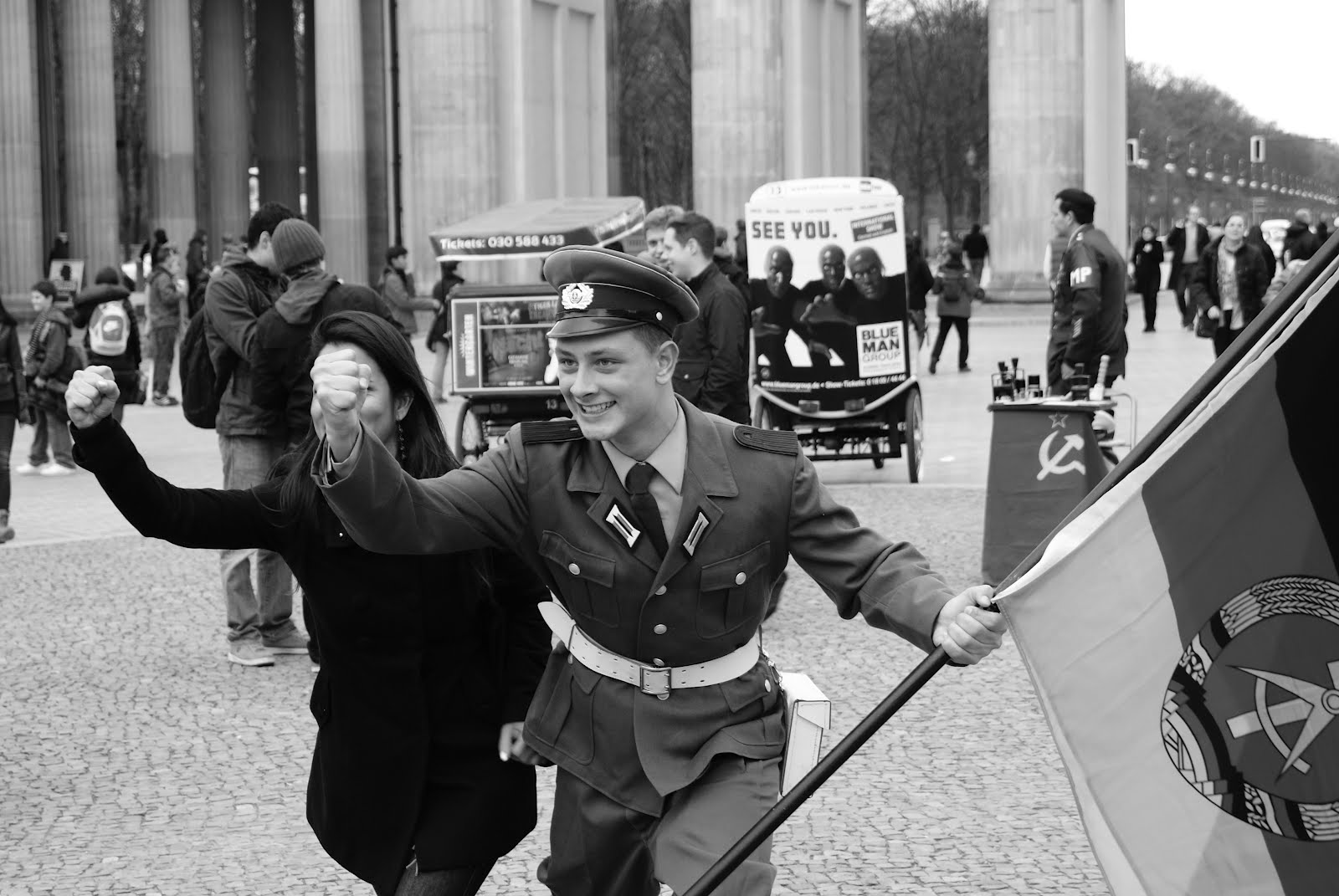
This is a picture on Day 3 of a posing East German Soldier beneath Brandenburg Gate.

Berlin, Germany 2012

Here is an exact replica of the sign at Checkpoint Charlie along the former East-West Berlin Border.

Berlin, Germany 2012

This is a picture of Checkpoint Charlie. Checkpoint Charlie is the name given by the Western Allies to the best known crossing point between East Berlin and West Berlin during the Cold War. During the Berlin Crisis of 1961 this was the sight of a Soviet and American 20 tank standoff that lasted for 6 days.

Berlin, Germany 2012

One last picture here of the Berlin Wall at the East Side Gallery. The remaining portion of the wall extends 1.3km, making the East Side Gallery the world's largest open air art gallery.

Berlin, Germany 2012

This is perhaps the most famous mural painted along the wall. It depicts Leonid Brezhnev, the General Secretary of the Soviet Union, and Erich Honecker, the East German leader.

Berlin, Germany 2012

Another mural painted along the wall at the East Side Gallery.

Berlin, Germany 2012

The Cold War graffiti no longer exists; instead, the curret murals hail from an international group of artists who gathered in 1989 to celebrate the wall's fall.

Berlin, Germany 2012

We started Day 2 by going to the East Side Gallery where the last significant remains of the Berlin Wall exist.

Berlin, Germany 2012

After sightseeing all day we spent the evening relaxing on the terrace in Hackescher Market.

Berlin, Germany 2012

Here is a picture of the Berliner Dom, Humboldt-Box, and the Fernsehturm (Television Tower) all lined up next to each other.

Berlin, Germany 2012

Another HDR photo of the Berliner Dom on Museum Island.

Berlin, Germany 2012

This is an HDR photograph of the Altes Museum located adjacent to the Berliner Dom on Museum Island. The Altes Museum was constructed in 1830 and designated an UNESCO World Heritage Site in 1999.

Berlin, Germany 2012

After leaving the Kunsthaus Tacheles we walked to Museum Island, located within the city center. This is an HDR photograph of the Berliner Dom (Berlin Cathedral) located on Museum Island. After undergoing several transformations from 1500-1800, the structure you see here was built in 1893. The Cathedral was renovated several times throughout the next century due to damage caused during WWII.

Berlin, Germany 2012

Another picture here of the Kunsthaus Techeles from the backside.

Berlin, Germany 2012

This a picture taken within one of the art galleries in the Kunsthaus Tacheles.

Berlin, Germany 2012

Berlin is notorious for utilizing old, abandoned warehouses for art galleries, and techno clubs. This was a warehouse called Kunsthaus Tacheles that I stumbled upon near Hackescher Market, north of the city center. During World War II this building served as a Nazi prison. After the Berlin Wall had fallen down the building was taken over by artists. The artists collective is continuously threatened by eviction. The building currently contains artists studios, workshops, a nightclub, and cinema.

Berlin, Germany 2012

Just a few blocks away from Reichtag lies the Brandenburg Gate. Brandenburg Gate was originally built in the 1730's as a main entrance to the old fortified city. However after the fall of the Berlin wall in 1989, the gate symbolized freedom and the desire for unity between east and west Berlin. This was also the site of significant speeches given by American presidents. John F. Kennedy's speech in 1963 and Ronald Reagan's speech in 1987 were both held at this location on the West Germany side.

Berlin, Germany 2012

This is another HDR picture of the Reichstag.

Berlin, Germany 2012

This past week I traveled with a friend to the city of Berlin. I experimented with a new kind of photography called HDR (High-Dynamic Range). Many of the photos you will see will be HDR and create a hyper-realistic experience. This photo here was taken the first day in Berlin of the Reichstag. The Reichstag was originally constructed in 1894 to house the Parliament of the German Empire. The building underwent significant reconstruction in the 90's after the building was severely damaged during the Cold War and the years that followed.